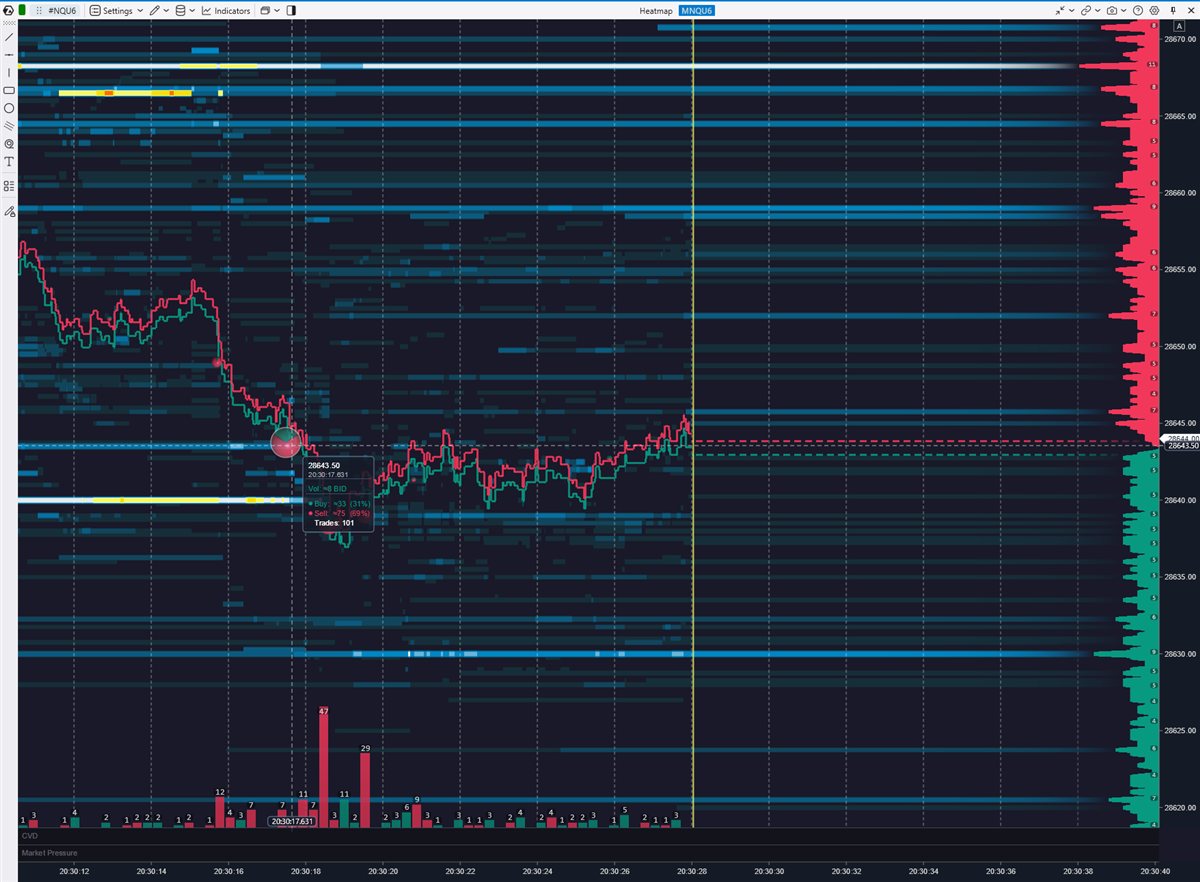
Footprint shows trades that already happened — the facts. But the market has another layer of information: orders that are still waiting. Limit orders sitting in the book — the intentions of buyers and sellers. That's exactly what the Heatmap visualises.
If the market is an auction, the heatmap is the floor plan of the room: you see where the big participants are gathered and at which prices they're prepared to trade. Price moves toward liquidity — knowing where it sits is a real edge.
What is the Heatmap?
The heatmap is the history of market depth painted onto the chart in colour. Every horizontal band shows how many limit orders sit at that price: the brighter the colour, the more liquidity. Large bright bands are what traders call liquidity walls.
The key distinction: footprint shows market orders (aggression, facts), heatmap shows limit orders (the passive side, intentions). They're two different sides of the auction, and the full picture only appears when you put them together.
How to read it in practice
1. Liquidity walls
A bright band above price — heavy supply on offer; below — demand. As price approaches a wall, it usually does one of two things: bounces (the wall withstands the aggression) or breaks through and accelerates (the wall gets pulled or eaten). The wall's existence alone doesn't tell you which happens — but it tells you exactly where to pay attention.
2. Magnet and brake
Liquidity works both ways. A big wall can attract price — the market likes to test large orders. And it can stop it — if the orders are real and actively traded into. Watch the sequence: price approaches → does the wall stay? → is it being traded into (footprint!) → who wins?
3. Disappearing orders are a signal too
If a large wall "melts" as price approaches — the participant no longer wants to trade there, or never did. Orders that vanish suddenly often mean spoofing — theatrical orders meant to scare. That's why the heatmap is never read literally.
Careful: a limit order is not a commitment. It can be cancelled at any moment. The real information is not the order's size but its behaviour as price approaches: does it stay or vanish, is it traded into or not. Always check heatmap intentions against footprint facts.
What does it give you?
- You see where the market may stall. Instead of guessing "where's resistance" — you see where supply actually sits.
- Better entry and exit planning. Understanding where liquidity is means understanding where price can accelerate and where it can get stuck.
- Intentions + facts = the full picture. Heatmap together with footprint lets you watch both sides of the auction at once.
- Fewer naive mistakes. Once you understand spoofing, you stop blindly trusting "huge walls" from social media screenshots.
How to start in ATAS
- Get the ATAS demo (14 days free).
- Enable the Heatmap mode on the chart (Chart → Heatmap) — colour scheme is up to you.
- Open footprint or Smart DOM alongside — so you see intentions together with facts.
- For a week, just observe: how does price behave near big bands? When do walls hold, when do they vanish?
Try ATAS for free
Heatmap, Footprint, Smart DOM and Volume Profile — all in one professional platform. 14-day demo with real data.
FAQ
Are liquidity walls always real?
No. Limit orders can be cancelled — some big orders are theatre (spoofing). What matters is not the wall, but its behaviour as price approaches: a real wall stays, and gets traded into.
How is Heatmap different from Footprint?
Footprint shows executed trades (facts), Heatmap shows waiting limit orders (intentions). They're strongest together.
Does Heatmap work in every market?
It needs market depth data. In futures markets that's standard; capability depends on your data package.
Can I try it for free?
Yes — the ATAS demo runs 14 days. Link above.
Want the full foundation?
Leave your email on the homepage — you'll get the Market Auction Theory summary (PDF) and be first to know when the course opens.