Price is rising. But who is lifting it? Aggressive buyers forcing the market up? Or is simply nobody selling, and price drifts higher with no force at all? You can't tell from a plain candle — both situations look identical. And for trading, the difference is everything.
That question is answered by delta — arguably the most important orderflow number. And by its session-wide version, CVD (Cumulative Volume Delta), which shows the overall direction of pressure across the whole day.
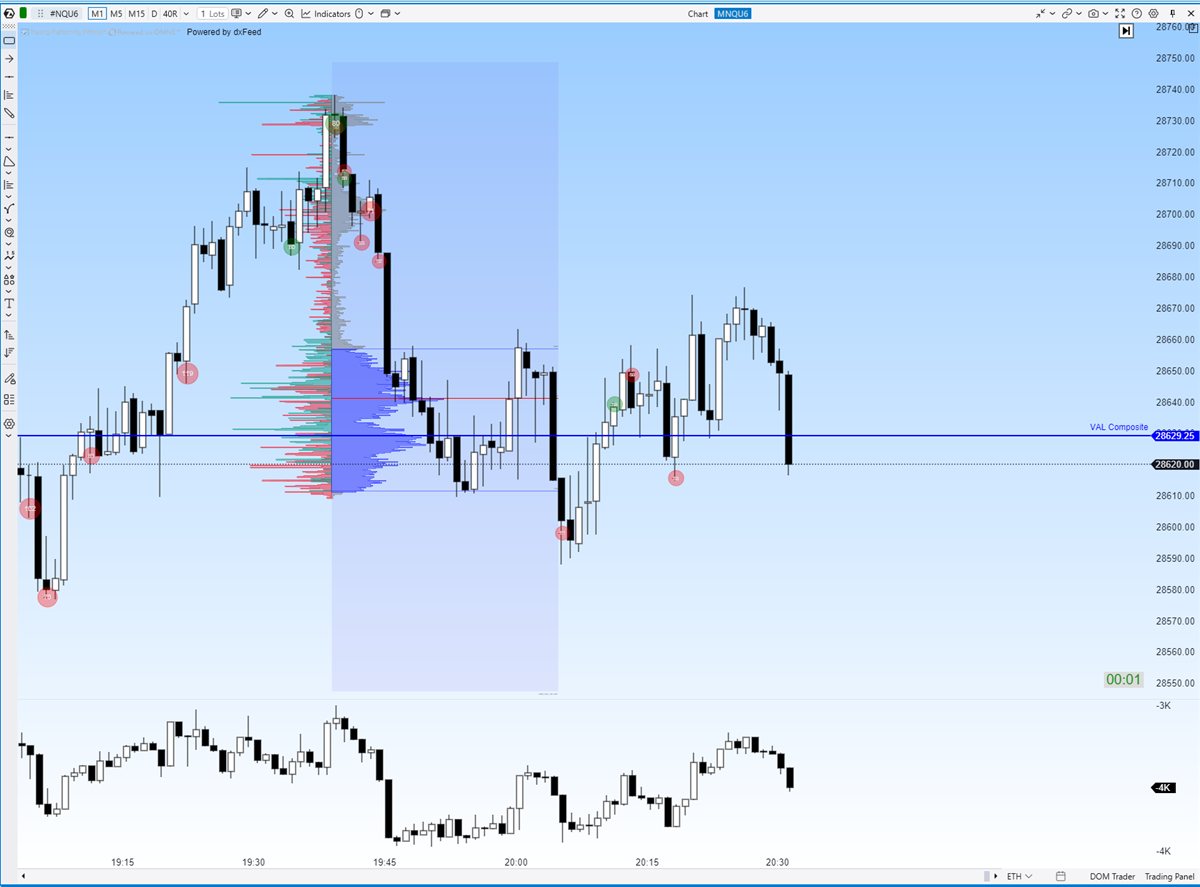
What is delta?
Every trade has an aggressor: either a buyer "takes" the ask (market buy), or a seller "hits" the bid (market sell). Delta is their balance:
delta = market buys − market sells
If a candle has 2,000 contracts bought aggressively and 1,400 sold — delta is +600: buyers were pressing. Negative delta — sellers. Delta measures aggression, not just turnover: big volume with neutral delta means a fight, not a direction.
What is CVD?
CVD is cumulative delta: every candle's delta stacked up from the session open, drawn as a line below the chart. It shows which side is winning the aggression war across the whole day. CVD rising — aggressive buyers dominate the day. Falling — sellers.
The powerful part: CVD can disagree with price. And it's exactly the disagreements that say the most.
How to read it in practice
1. Confirmation: price and CVD move together
Price rises, CVD rises — the move is driven by real buyer aggression. A healthy imbalance: the auction is moving to find new value with force behind it. Pullbacks in such moves tend to be shallow.
2. Divergence: price makes a new extreme, CVD doesn't
Price prints a new high of the day while CVD stays below its previous peak. The new high was made with less and less aggression — the engine is running out of fuel. It's a warning that the move may be mature. But careful: a divergence is a warning, not a signal. Strong trends can diverge for hours.
3. Absorption: strong delta, price stands still
Strongly positive delta, and price doesn't budge. Aggressive buyers keep buying — and someone calmly sells them everything with limit orders. The passive side is absorbing the aggression. If price then drops — the buyers are trapped, and their stops become fuel for the move down. One of the strongest reversal scenarios, and delta (together with footprint) is what lets you see it.
Auction context changes everything: delta at the edge of a value area, at yesterday's extreme, or after a long balance means a lot. Delta in the middle of nowhere means nothing. First ask where the auction is (balance or imbalance, where value sits), then ask what delta says.
Common traps
- Delta ≠ holy grail. Passive orders move markets too — in absorption it's exactly the passive side that wins, even though delta points the other way.
- Don't compare absolute numbers across days. Activity levels change; relative force and shape matter more than raw size.
- CVD can differ between platforms — it depends on the data feed and calculation. Use one platform consistently.
- Don't build signals from one line. Delta works as confirmation within auction context, not as a standalone system.
How to start in ATAS
- Get the ATAS demo (14 days free).
- Add the Cumulative Delta indicator below your chart — that's your CVD line.
- On the footprint chart, enable delta below each candle.
- A one-week exercise: every time price makes a new extreme of the day, check — does CVD confirm it?
Try ATAS for free
Cumulative Delta, Footprint, Heatmap, Big Trades — the full orderflow arsenal in one platform. 14-day demo with real data.
FAQ
Does positive delta mean price will rise?
Not always. Positive delta shows aggressive buyers — but if passive sellers absorb them, price doesn't rise, and that's often a reversal warning.
What's the difference between delta and CVD?
Delta is one candle's aggression balance. CVD is those values summed across the session, showing the day's overall direction of pressure.
What does a delta divergence mean?
Price makes a new extreme, CVD doesn't confirm — the move is running on less and less aggression. A warning, not an automatic signal.
Can I try it for free?
Yes — the ATAS demo runs 14 days, link above.
Want the full foundation?
Leave your email on the homepage — you'll get the Market Auction Theory summary (PDF) and be first to know when the course opens.